
April 16: April in Lyon
SuperTrip 2026 Blog Post
2026 BLOG
4/16/20262 min read
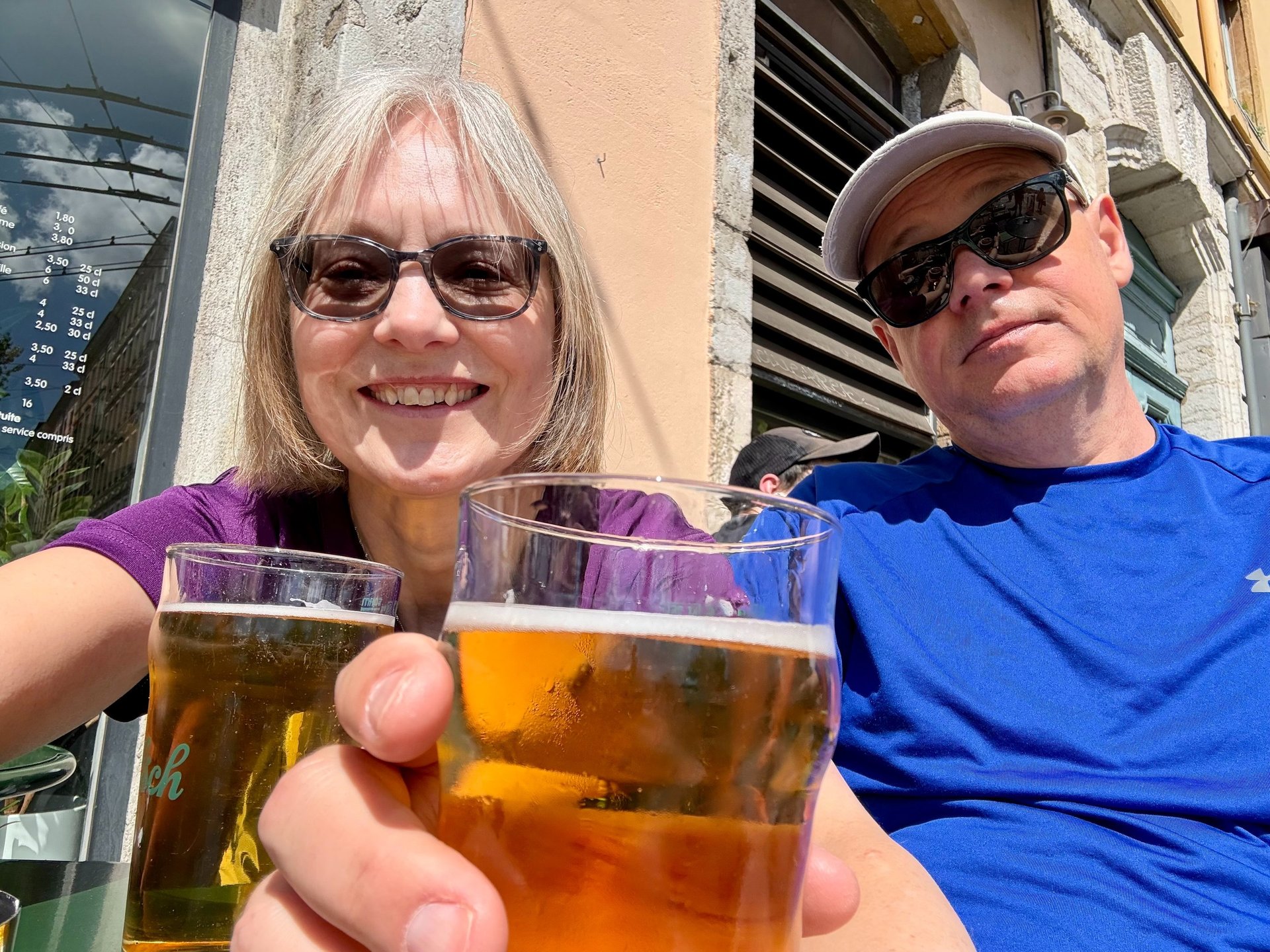
Today was our first full day in Lyon. We left Paris yesterday, taking our places in carriage 16 (of 20!) on the TGV to Leon Part Dieu. The train oozed through the countryside with barely a hum, taking just about two hours to cover the 400km between the two cities. We are staying on the banks of the Saône river, looking across (and up) to the Gallo-Roman settlement (and UNESCO World Heritage site) of the “Hill of Lugus”, which gave the city its ancient name of “Lugdunum”, which has been corrupted over time to today’s “Lyon”. The lion crest was adopted for the city in the Middle Ages reflecting a fake/folk etymology which seemed to befit a rich and thriving town.
The hill fort (“dugnum”) of the Allobroges, dedicated to their God of Light, fell to the Romans and was reestablished as a Roman town by veterans who had served under Julius Caesar. Lyon has the earliest attested Christian church West of Rome, dating to 150 CE, whose ruins can still be seen. By that time, Lyon was one of the greatest cities in the Empire and the capital of the Province of Gaul. Lyon boasted an enormous theatre complex, which was extended by the Emperor Hadrian to accommodate 10,000 people. The ruins are vast and unmistakable, with amazing views over the Rhône valley.
The Church ruled the city in the Middle Ages: the Archbishop of Lyon held the title “Primate of All the Gauls”. Two Popes were crowned in Lyon and the military monastic orders had major centres in the city. However, during the 16th Century, Lyon fell into Protestant hands and the Cathedral was sacked by the victorious Hugenots. Even visiting today, you can’t help but notice the heads are snapped off all the saints on the external reliefs and that the inside has modern windows and bare stone walls.
It stands in stark contrast to the Basilica which looms above it on the hilltop. The Basilica (de Notre Dame de Fourvière) was built in the late 19th Century. It is opulently skinned with baroque marble on the outside and Byzantian gilded tile frescos on the inside. Dedicated to the Virgin in recognition of her part in sparing the city from plague in 1643 (an event still celebrated every December) and from the Prussians in 1870. It is Lyon’s equivalent of the Sacré Coeur: built in white marble, by public subscription, on the best hilltop available, in the wake of the passing of an existential threat.
We visited all these sites today, in no hurry. We also enjoyed the tranquil Loyasse cemetery (modelled after the Père Lachaisse cemetery in Paris) and a trip to Les Halles du Lyons for a late lunch. The weather was ideal for walking – bright with a breeze, rising to 20 degrees by late afternoon. And, the city is small, although it’s also hilly. My watch recorded the equivalent of 30 sets of stairs (around 100m), although only 10km of actual distance.
Follow our Journey at:
Email us at:
Karen's Podcast at:
© 2025. All rights reserved.
Inspired by our 2024 Camino Francais, Karen has a periodic podcast called "I sent you a bloody boat", personal thoughts on faith by a person who believes in thinking. Also, known as "The Reluctant Christian". You can listen to it on Spotify and on Apple Podcasts at: